Mokko Namako Sukashi - TM019
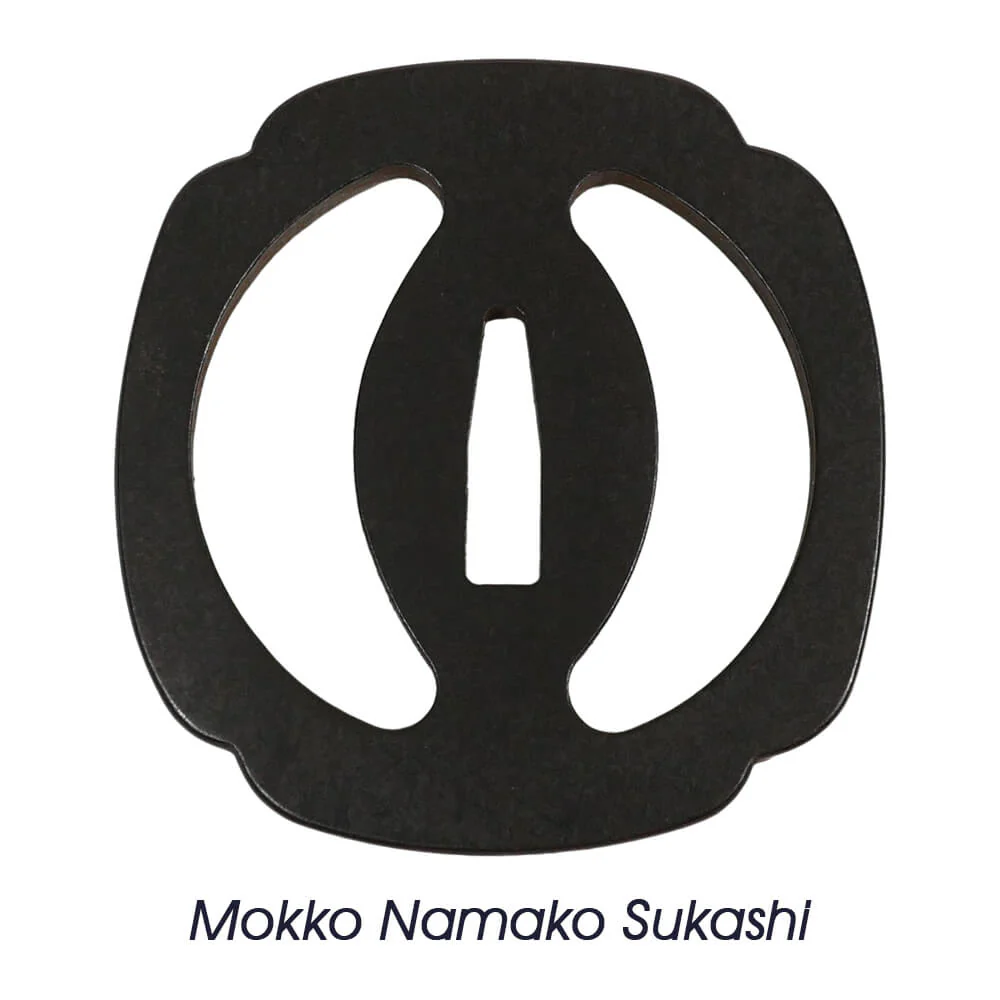
Mokko Namako Sukashi - TM019
Two facing sea cucumbers (Holothuroidea), called Namako in Japanese within a Mokko shape.
Sea cucumbers have inspired thousands of haiku in Japan, where they are called namako (海鼠), written with characters that can be translated as "sea mice" (an example of gikun).
The "Mokko" shape refers to a flower called Chaenomeles speciosa, or Japanese quincein English, particularly important during the ancient times for its use in traditional medicine.
- Material: Blackened iron
- Weight: 110 g
- Vertical height: 75 mm
- Horizontal width: 72 mm
- Thickness: 5 mm
This Tsuba is part of a high-end series (from TM018 to TM029) and is made of a traditional Tetsuji Iron, blackened with special iron lacquer. The process is optimized to obtain a result that reproduces ancient Tsuba as they were when new. To limit the cost, the cut is mechanical but hand-guided. The iron black lacquer is done by a specialist, similarly to how it is done on other swords parts or Yoroi (armors).
Original: $105.00
-70%$105.00
$31.50Product Information
Product Information
Shipping & Returns
Shipping & Returns
Description
Mokko Namako Sukashi - TM019
Two facing sea cucumbers (Holothuroidea), called Namako in Japanese within a Mokko shape.
Sea cucumbers have inspired thousands of haiku in Japan, where they are called namako (海鼠), written with characters that can be translated as "sea mice" (an example of gikun).
The "Mokko" shape refers to a flower called Chaenomeles speciosa, or Japanese quincein English, particularly important during the ancient times for its use in traditional medicine.
- Material: Blackened iron
- Weight: 110 g
- Vertical height: 75 mm
- Horizontal width: 72 mm
- Thickness: 5 mm
This Tsuba is part of a high-end series (from TM018 to TM029) and is made of a traditional Tetsuji Iron, blackened with special iron lacquer. The process is optimized to obtain a result that reproduces ancient Tsuba as they were when new. To limit the cost, the cut is mechanical but hand-guided. The iron black lacquer is done by a specialist, similarly to how it is done on other swords parts or Yoroi (armors).